Why Reflux Can Still Reach Your Throat at 1 A.M. — Even When You Take an Acid Reducer
The nighttime reflux problem is not always about how much acid your stomach makes. It may also be about whether anything is physically holding it down while you are lying flat.

It is 1:00 in the morning.
You are lying flat, asleep, and unaware of what is happening below your chest.
You may wake with a sour taste. A dry, raw throat. A cough that was not there when you went to bed. Or you may sleep through the episode entirely and notice only the evidence the next morning: throat clearing, hoarseness, or a voice that takes an hour to sound normal.
This can be especially confusing if you already take an acid reducer.
You may think: If my medication reduces acid, why am I still waking up with reflux symptoms?
- You wake with a sour taste — or a dry, raw throat that was not there at bedtime
- You have a cough at night that you do not have during the day
- Your voice takes an hour to sound normal in the morning
- You clear your throat constantly, and you are not sure why
- Your chest symptoms improved on an acid reducer — but your throat symptoms did not
- You sleep through the episode entirely and only see the evidence the next morning
The answer may be that nighttime reflux involves two different problems:
How acidic the stomach contents are.
Whether those contents can travel upward when you are lying flat.
Acid reducers are designed to address the first problem.
They do not create a physical layer over the stomach contents while you are horizontal and asleep.
That distinction is the starting point for understanding why a Day & Night approach may make more sense than treating every reflux episode as the same.
Why nighttime reflux behaves differently
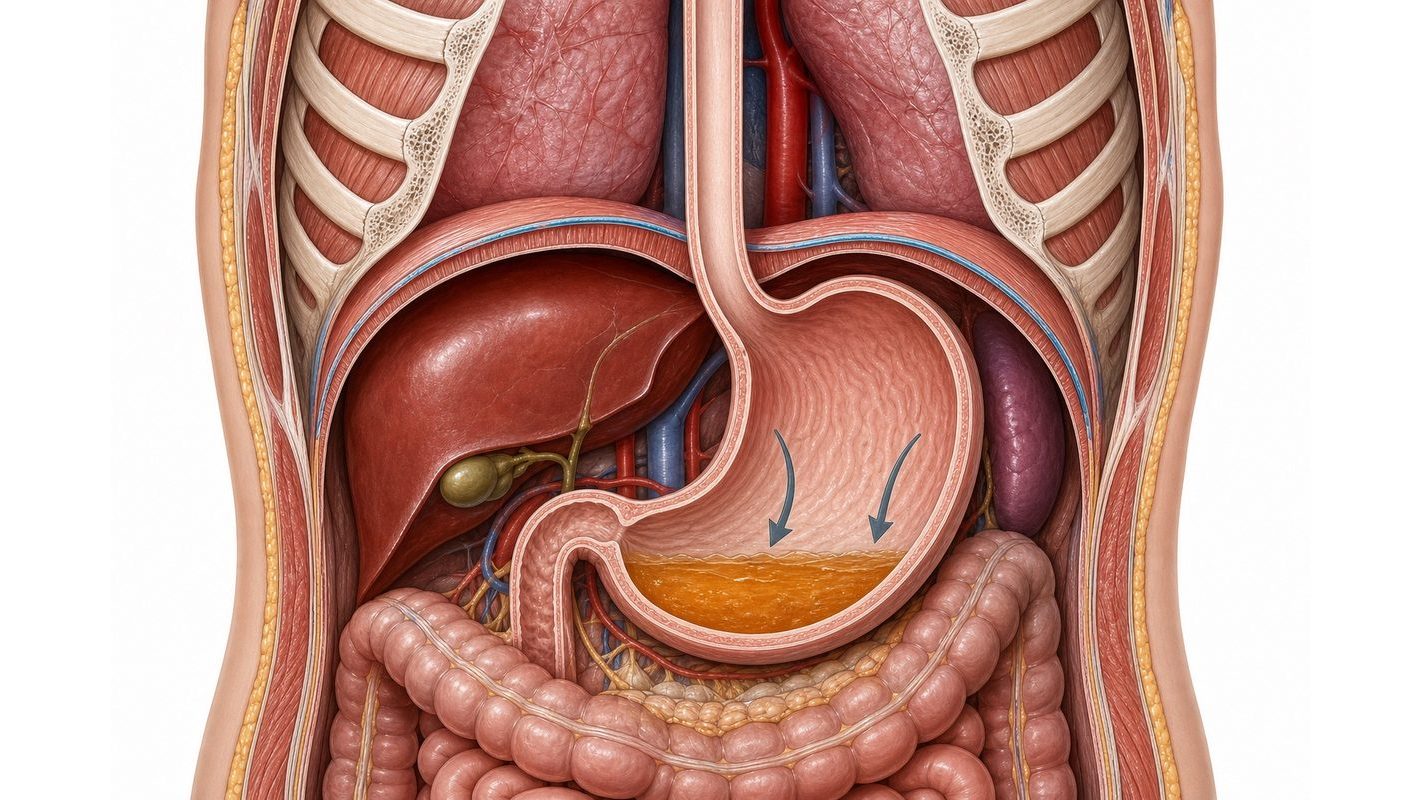
During the day, gravity is working in your favor.
You are upright. You move around. You swallow regularly. If stomach contents move upward, your body has more opportunities to clear them back down.
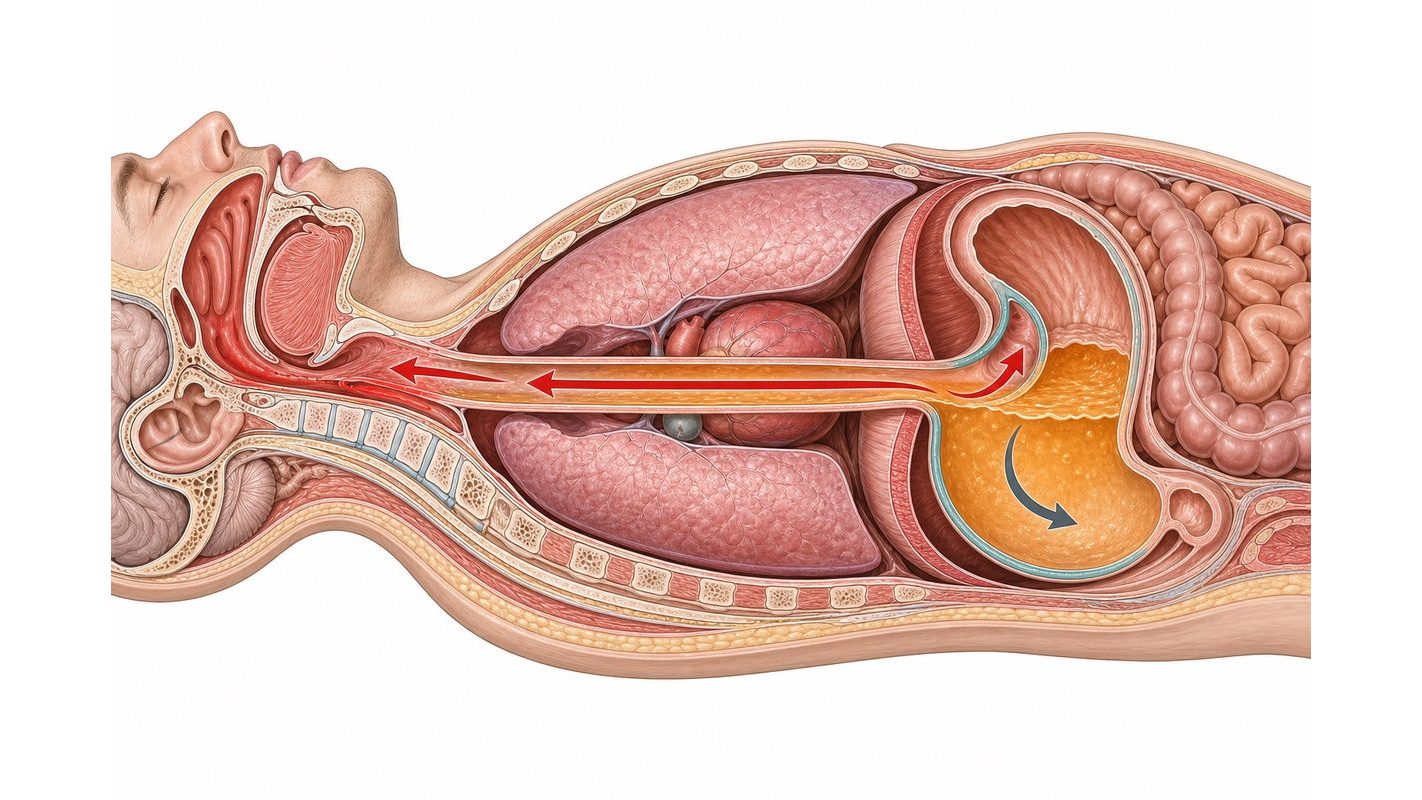
At night, those defenses are reduced.
You are lying flat for hours. You are not walking, eating, or swallowing normally. You may not feel every small episode of reflux, especially if it does not produce the familiar burning sensation in your chest.
That is one reason nighttime reflux can show up as morning throat symptoms instead of obvious heartburn.
Researchers use the term nocturnal acid breakthrough to describe reflux activity that can occur during sleeping hours, including in people who are already using acid-suppressing medication.
The phrase matters because it challenges a common assumption: that reducing acid automatically means nothing can move upward.
It does not.
Acid reduction changes the contents. It does not physically hold those contents down.
The trial that helps explain persistent throat symptoms
This difference is particularly relevant if your chest symptoms improve but your throat symptoms do not.
In the 2021 TOPPITS randomized trial, people with persistent throat symptoms such as hoarseness, coughing, and the sensation of something in the throat received either a high-dose proton pump inhibitor or a placebo.
At the end of the study, the acid-suppression group did not report significantly better outcomes than the placebo group for those throat symptoms. Read the TOPPITS trial here.
That does not mean acid reducers never help. They can be useful for the acid component of reflux.
It does suggest that acid reduction alone may not cover every situation in which reflux reaches the throat.
One reason is that reflux is not made of acid alone. It can also carry digestive substances such as pepsin upward. Research has shown that pepsin can be taken up by laryngeal tissue. See the research on pepsin and throat tissue.
Other research suggests pepsin can become less active in a less acidic environment and reactivate when exposed to acid again. Review the pepsin research here.
So a person can experience a frustrating mismatch:
- The classic burning sensation is less intense.
- The throat still feels irritated in the morning.
- The cough, hoarseness, or need to clear the throat continues.
The chemistry may have changed. The upward movement may still be occurring.
The post-meal acid pocket: a physical target
There is another important piece of the reflux picture.
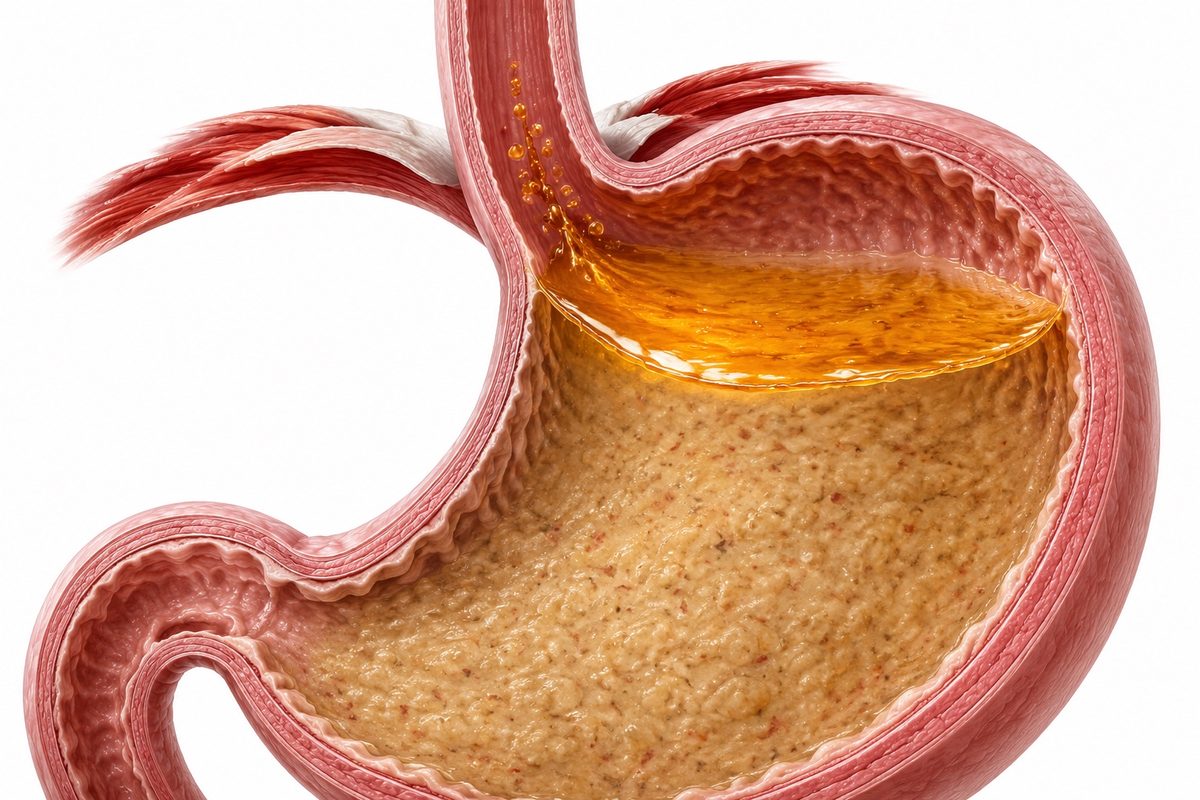
After you eat, a concentrated pocket of acid can form near the top of the stomach, close to the entrance of the esophagus. Researchers call it the post-meal acid pocket.
That location helps explain why reflux often appears after meals and why lying down too soon can make it worse. The pocket is already close to the doorway. If stomach contents move upward, they do not have far to travel.
This is where alginate works differently from an acid reducer.
When alginate is mixed with water and reaches the stomach, it can rise to the surface of the stomach contents and form a floating raft. The raft is not intended to change the stomach's natural acid production. It creates a physical layer between the stomach contents and the esophageal opening.
In human imaging studies, an alginate raft was observed settling over the post-meal acid pocket and displacing it downward, away from the esophageal entrance. See the human imaging research.
That gives the mechanism a simple explanation:
And the distinction is not just theoretical. A 2017 systematic review and meta-analysis of randomized trials found that alginate therapy more than quadrupled the odds of reflux symptom relief compared with placebo or antacid alone, with an odds ratio of 4.42. Read the meta-analysis.
Individual results vary, and alginate is not a cure for GERD. But the physical-barrier mechanism has been observed in humans, and it addresses a part of reflux that acid suppression does not physically address.

[ CTA destination — link to product page ]
Why one reflux routine may not fit both windows
The conditions are different after a meal and after you go to bed.
The daytime window
After a meal, the stomach is full and the post-meal acid pocket may be positioned near the esophageal entrance. Eating, bending, moving, and lying down can all create opportunities for contents to travel upward.
That is the window a post-meal raft is designed to support.
The nighttime window
At night, the central problem is position and duration. You are flat. You are still. Gravity is no longer helping in the same way. You may not wake during every episode, so the first sign may be a rough throat or hoarse voice in the morning.
That is the window a bedtime raft is designed to support.
Instead of treating reflux as one single event, the Day & Night approach separates the two situations:
The Day & Night system

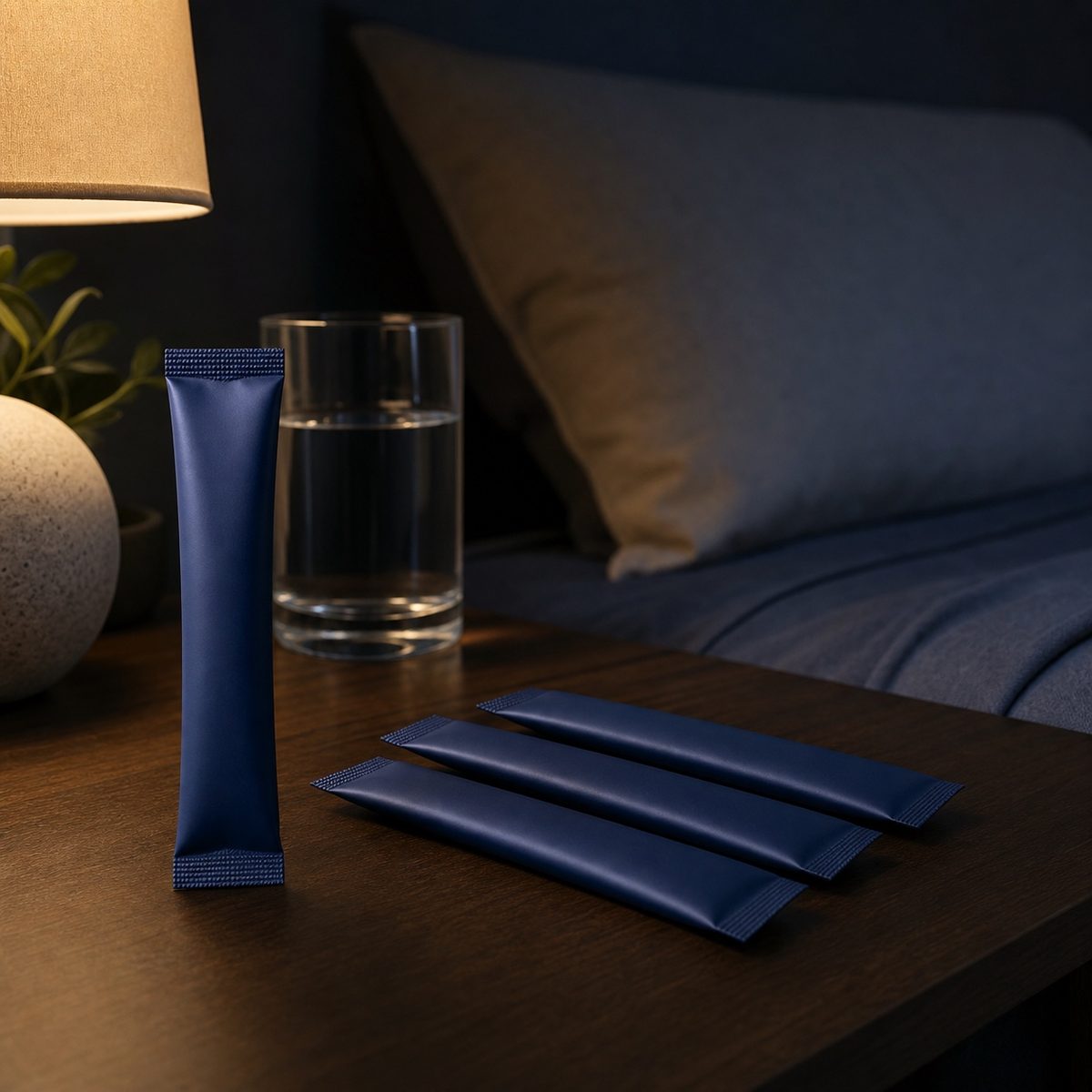
Concept renders — unbranded placeholder packaging, to be replaced with the final artwork.
The Day & Night system was built around that distinction.
Day Raft
Day Raft is the after-meal formula. Mixed with water, its alginate forms a floating raft over the stomach contents, creating a physical barrier designed to help reduce the upward movement of acidic material during the post-meal window.
Night Raft
Night Raft is the bedtime formula, supplied in a single-serve stick powder. It is built around the nighttime window, when lying flat removes gravity's help and reflux may occur without waking you.
- Sodium alginate1,500 mg
- Potassium bicarbonate300 mg
- Calcium carbonate200 mg
- L-theanine150 mg
- Flavor and sweetener—
The goal is not to pretend that stomach acid is irrelevant.
The goal is to address the part of the problem that acid reducers were not designed to address: the physical movement of stomach contents while you are horizontal.
Because alginate works through a physical barrier rather than by suppressing natural acid production, it follows a different pathway from acid blockers. In a wash-out study, stopping alginate was not associated with the rebound pattern observed in the comparison group.
If you currently use a prescribed PPI, H2 blocker, or other medication, do not stop or change it based on this article. Speak with your healthcare professional before changing prescribed treatment.
[ CTA destination — link to product page ]
The question most people never think to ask about nighttime reflux

That is the part most people never think to ask about.
Not just how acidic is my stomach? but when I am lying flat at 1 a.m. and completely asleep, what is actually stopping it from moving upward?
The answer to the first question already exists. You may already be using it.
The answer to the second question is what the Day & Night system was built around.
Day Raft handles the post-meal window: the alginate raft, the floating physical barrier, the acid pocket. You have already read how that works.
Night Raft handles the window that acid reducers were never designed to cover: the long hours you spend flat, still, and not swallowing. A single stick at bedtime, built around the same alginate mechanism, timed for the moment gravity stops helping you.
If this article did anything, it drew a line between two problems that usually get treated as one. The system exists because that line is real.
There is one more thing worth seeing before you decide anything. The product page walks through how the two formulas are actually used together, what to expect in the first week, and what the 30-day guarantee covers if it is not the right fit for you.
That is the next step, not because this is a sales pitch, but because the article stops where the practical question starts.
SEE HOW THE DAY & NIGHT SYSTEM IS USED 👉[ CTA destination — link to product page ]
What readers are saying
[ verbatim review text ]
[ verbatim review text ]
[ verbatim review text ]
[ CTA destination — link to product page ]
Sources
- O'Hara J et al. TOPPITS randomized trial of proton pump inhibitor vs. placebo for laryngopharyngeal reflux symptoms. BMJ (2021). https://pubmed.ncbi.nlm.nih.gov/33414239/
- Johnston N et al. Pepsin uptake and persistence in laryngeal epithelial cells. Annals of Otology, Rhinology and Laryngology (2006). https://pubmed.ncbi.nlm.nih.gov/16466100/
- Koufman JA and Johnston N. Potential role of pepsin in the pathogenesis of laryngopharyngeal reflux. The Laryngoscope (2012). https://pubmed.ncbi.nlm.nih.gov/22844861/
- Rohof WO et al. Alginate raft displacement of the post-meal acid pocket. Clinical Gastroenterology and Hepatology (2013). https://pubmed.ncbi.nlm.nih.gov/23639602/
- Leiman DA et al. Systematic review and meta-analysis of alginate therapy for gastroesophageal reflux symptoms. Diseases of the Esophagus (2017). https://pmc.ncbi.nlm.nih.gov/articles/PMC6036656/
This article is for educational purposes. Individual results vary. The Day & Night system is designed to support comfort around reflux symptoms and is not intended to diagnose, treat, cure, or prevent any disease.